How Ancestral Stories of Blackthorn Inform Contemporary Healing Narratives: Intro (Table of Contents, Abstract, Lit Review, Methodology)
Table of Contents
In Western cultures, a drive for individualism and accumulation has frequently led to severance of familial and cultural ties, which leaves individuals with a sense of alienation and societies with limited solutions to systemic inequities in healthcare access. The nature of dis-ease in many traditional societies is attributed to disharmony with nature and is viewed in a communal rather than individual context. Stories are (co-)created narratives of metaphorical or perceived events, which are communicated for the purpose of entertainment, identity/memory formation, education and unification. As communicative rituals, stories aid in the transmission of ancestral knowledge, community healing/protection/regulation and making sense of the world through connection with the landscape. Collaborative conception of shared realities facilitates healing, as defined by the person or community being healed, while helping humans navigate complicated and seemingly conflicting truths. On the island of Éire, a strong history of oral communication has enabled the transmission of ancestral knowledge in respect to cures, fluid societal expectations and stories of the land, while incorporating varied perspectives introduced through migration, invasion and global cooperation. The story of Blackthorn, rooted and tangled throughout Irish folklore, is illustrative of the capacity of story to heal, through instruction and connection. Irish vernacular relationships with Blackthorn demonstrate diverse implementations of ancestral knowledge, which mirror global pathways for narrative healing. Story medicine resists institutional control by providing empathy and agency. It imparts an expansive understanding of healing, embedded in community well-being, that is well suited to alleviate diseases of poverty, colonialism and white supremacy, even in combination with allopathic medicine.
Previous literature on folk healing, story in human experience, narrative medicine and vernacular/folkloric relationships with Blackthorn is well established. Through a review of the complex relationships between formal and informal medicine in Ireland, Foley acknowledges how folk medicine “emerged organically to fill natural and socially constructed gaps,” while remaining resistant to complete suppression by institutional medicine.[1] Lindahl utilises diverse case studies to demonstrate the ability of story to enact personal and community healing by providing a container for reconciling conflicting truths and shifting personal narratives to co-create new realities.[2]
Mehl-Madrona calls for a storied, indigenous approach to healthcare that honours personal and community narratives. He acknowledges the benefits and failures of allopathic medicine and posits the importance of treating the story rather than the dis-ease.[3] This embodied and holistic approach to healing is also promoted by Sunwolf[4], Livo[5] and Rubenstein[6], while Wilce scrutinises how story medicine functions in respect to language.[7] Mattingly and Lawlor explore how narrative medicine survives in the biomedical setting through spontaneous and contrived interactions between healers, patients and families.[8] Dow identifies universal structures in symbolic healing rituals through the use of mythic archetypes and relates their efficacy to psychological processes.[9] This paper will attempt to present a more embodied approach to storied medicine that resists Western psychological frameworks as the author endeavours to decolonise their own understandings of healing.
Within early Irish[10] agrarian society, Jenkins probes how social and supernatural scapegoats promote social cohesion in the face of matriarchal domestic economies and uncertain agricultural outcomes.[11] The use of narrative charms for healing in Ireland is considered by several scholars.[12] A similar preservation of orally transmitted charms has been documented in the Balkans with an emphasis on specific cultural and linguistic factors that aid in resilience.[13] Alderson uplifts the Irish diaspora as having a critical role in global decolonisation efforts, while appealing for ancestral accountability in perpetuating oppression of other groups after escaping colonisation.[14] It is essential to recognise this complicated history and its shifting power dynamics, when discussing “Irish” traditions in terms of indigeneity or comparing the ancestral practices of the island to other traditional groups.
The National Folklore Collection at University College Dublin contains a multitude of references from folkloric and ethnographic interviews on Blackthorn relationships, which help to construct an overview of the story of Blackthorn in the land now known as Ireland. Vernacular relationships with Blackthorn are well documented by herbal Materia Medica[15] and collections of plant lore.[16] Martial arts scholar, John Hurley, has been instrumental in elevating the art of bataireacht[17] as a form of defence, identity formation, resistance and social control.[18] Folklorist, Máire Mac Néill, captured many ritual interactions with Blackthorn, particularly faction fighting and its antecedents, in her extensive examination of the festival of Lughnasa.[19] These intimate relationships with Blackthorn and other sacred trees in the form of weapons connect faction fighters and modern practitioners to the Irish landscape and mythic ancestors.
A land-based predisposition toward fairy faith on the island of Éire has been documented by several scholars with a focus on the function of Otherworldly beings and their powers in vernacular narrative. Reidar Christiansen gives an overview of fairy faith in Ireland and the varied origins attributed to a “hidden race” across many cultures. He highlights the relationship between humans and fairies, which mirrors that of Blackthorn in terms of complexity and contradiction.[20] Richard Jenkins discussed supernatural scapegoating for the purpose of social cohesion in the face of uncertainty and disruption by colonial oppression. His work touched on both economic stress and conflicts arising from gendered community conventions.[21] Deirdre Nutall explored the moral apposition between the witch and the priest as protagonists imbued with supernatural powers and existing outside of society in opposite ways. Her analysis of these legendary characters stresses the epitomal gender expectations of Irish agrarian society on a surface level.[22] Radner and Lanser outline how coding is employed, decisively or subliminally, to convey meaning beneath the narrative façade.[23] Feminist coding in Irish narratives is scrutinised by Bettina Kimpton and Peter Narváez as they consider cautionary tales as warnings, commiserations and deflections of neurodivergence, sexual assault, infidelity and other taboo subjects.[24]
van Gennep identifies three stages in rites of passage – “preliminal rites (rites of separation), liminal rites (rites of transition), and postliminal rites (rites of incorporation).”[25] Upon passing through these stages, which may or may not always be clearly delineated, participants shift from one social or magico-religious role to another. Building on van Gennep’s work, Turner takes a closer look at the three stages with an emphasis on liminality, which is marked by a sense of being out of time and on the threshold of two different states – being neither this nor that. According to Turner, groups engaging in ceremonial rites of passage and rituals involving liminal states exist in “a ‘moment in and out of time,’ and in and out of secular social structure,” which” creates a sense of belonging or communitas.[26] This transitional process is intimately tied to sacred relationships with Blackthorn hedges. Vaughn’s exploration of Hawthorn in Ireland evokes for this study of Blackthorn, a thorough investigation of the complex nature of hedgerows as oppressive structures, protective mechanisms and liminal boundaries for magical interventions and rites of passage.[27]
Within these rituals, time and space are stretched and distorted by inversion of norms. In his analysis of the writings of Rabelais, Mikhail Bakhtin identifies carnivalesque characteristics arising from folk culture in the Middle ages through humour and grotesquery. He describes the temporary dissolution of traditional hierarchies, which then reinforce societal structure upon their return.[28] Continuing on this thread, Alessandro Falassi identifies specific elements of festival behaviour, which highlight both the symbolic inversions and heightened states of everyday behaviour “to renounce and then to announce culture.”[29] These subunits can be categorised into rites of reversal, intensification, trespassing, and abstinence.[30] Another element of festival or collaborative performance is play. Building on the work of Huizinga, Brian Upton explores the characteristics of play as “free movement within a system of constraints” – movement, freedom, rules, boundaries.[31] Within the enclosure of these restrictions, the everyday is freely cast aside in lieu of frivolity and meaning-making.
Bourdieu introduced a number of anthropological concepts, which were employed to examine gendered farming practices and identity formation.[32] Cultural capital refers to social assets of behaviour and knowledge, which can contribute to upward mobility. Social capital involves networks of people to which an individual has access and economic capital encompasses various assets, both current and promised, which are influenced by structural inequities. Bourdieu argued that these resources operationalize power and control through the concepts of doxa and habitus. Doxa are socially-shared and ingrained beliefs, which help guide behaviour and habitus is the innate reaction to these beliefs through socially situated perception and continued interaction with the world. These inclinations obscure and predispose individuals from a particular background to understand and experience the world in potentially limited ways, thus preventing upward mobility and fortifying status quo. Fields are the interconnected and nested spaces in which all of these interactions occur.[33]
In the field of material culture,[34] Victor Turner discussed the recognition of objects in a celebratory context as multivocal,[35] multivalent[36] and polysemous.[37] He cautioned that viewing material culture outside of ritualised context and not while in becoming, obscures the multifaceted symbols the object embodies while in action.[38] Turner outlines three categories of meaning – exegetical, operational and positional. Exegetical meaning is enacted by the belief systems and aesthetics of the practitioners interacting with the object. It can be broken down into sensory meaning, the physical form, and ideological meaning, the symbolic incarnation of group myth and values. Operational meaning is determined by the users of the item in relation to how and why they work with it and positional meaning situates the form within the cosmology of the group and its nested association with greater culture.[39]
Henry Glassie’s protocols for understanding material culture focus more on everyday interactions through contexts of creation, communication and consumption.[40] Contexts of creation are presented by the maker of the item and their collaborators, if any. They can include situations of concentration, learning, teaching, cooperation, technology, form, memory and hope. Contexts of communication are ways the object is presented to the eventual recipient and encompass circumstances of collaborative performance, donation and commercial exchange. Contexts of consumption – use, preservation and assimilation – are conceived by the end user and any future possessors.[41] These multidimensional frameworks help to uncover complexity of meaning in crystallised culture. Through his study of nostalgic re-presentations [sic] of outmoded material culture in County Tyrone, Ray Cashman, shows how “nostalgia can be essential for evaluating the present through contrast with the past and for reasserting the ideal of community in the midst of sectarian division.”[42] Layering new meanings on otherwise obsolete objects, through display and appreciation can contribute to constructive collaboration in the present.
Research for this paper began with an overview of existing literature on story or narrative medicine from cross-cultural perspectives, followed by an exhaustive examination of Blackthorn resources at the author’s disposal, including Irish vernacular relationships and greater European/North American associations. Several botanical volumes were located in the archive of the National Folklore Collection and University College Dublin, where print manuscripts and digital files were also sourced. The author’s limited ability to read as Gaeilge slowed and restricted this process, but there was a full review of all digital, English-language references to Blackthorn on dúcas.ie.[43] Further research was conducted into the Cailleach and related lore. Throughout two trimesters of coursework in the Folklore & Ethnology MA program at UCD, the author chose modules which would support their interests and research. They utilised and renegotiated prompts for module assignments to tailor work towards Blackthorn relationships and story medicine, resulting in early versions of several of the following chapters. Over three trimesters, the author engaged in collaborative brainstorming and feedback with professors and fellow students in support of this project and others. Through their affiliation with Strange Fox Fighting Arts, the author presented two workshops on Blackthorn Folk Medicine and The Hare in Irish Lore, which elicited discussions and questions, inspiring further thought. They were also interviewed by documentary filmmaker, Catherine Mercedes Judge as part of her research for a film on stick fighting as a form of resistance.[44] Research for this interview and the subsequent conversation unearthed valuable information. Low-risk study approval was obtained from the Human Research Ethics Committee in advance of a semi-structured, informational/person-centred interview with bataireacht instructor and tradition-bearer, Cuán McCann. The conversation was video and audio recorded for clarity, transcription and submission to the NFC. Themes from this interview were coded and analysed to provide context outside of the author’s lived experience when developing concluding thoughts.
The author’s intersectional identities create fields of constant introspection and negotiation. As both a biomedical laboratory professional and a clinical community herbalist, they are dedicated to resolving perceived conflicts between allopathic and folk medicine, while seeking global accessibility to culturally competent healthcare. This paper is an exploration of story medicine as one possible solution, which also has implications for greater social and environmental justice. As a queer, diasporic person, who engages in Irish martial arts, as taught through a queer and revolutionary lens, there is potential for limited understanding of native and/or heteronormative embodied experiences of this practice and other Blackthorn vernacular relationships. More broadly, as a member of the Irish and greater European diaspora learning on ancestral land, while negotiating life-long relationships with colonisation of the United States and culturally appropriate forms of folk medicine, the author strives to minimise romanticism, while maintaining an embodied approach to the material.
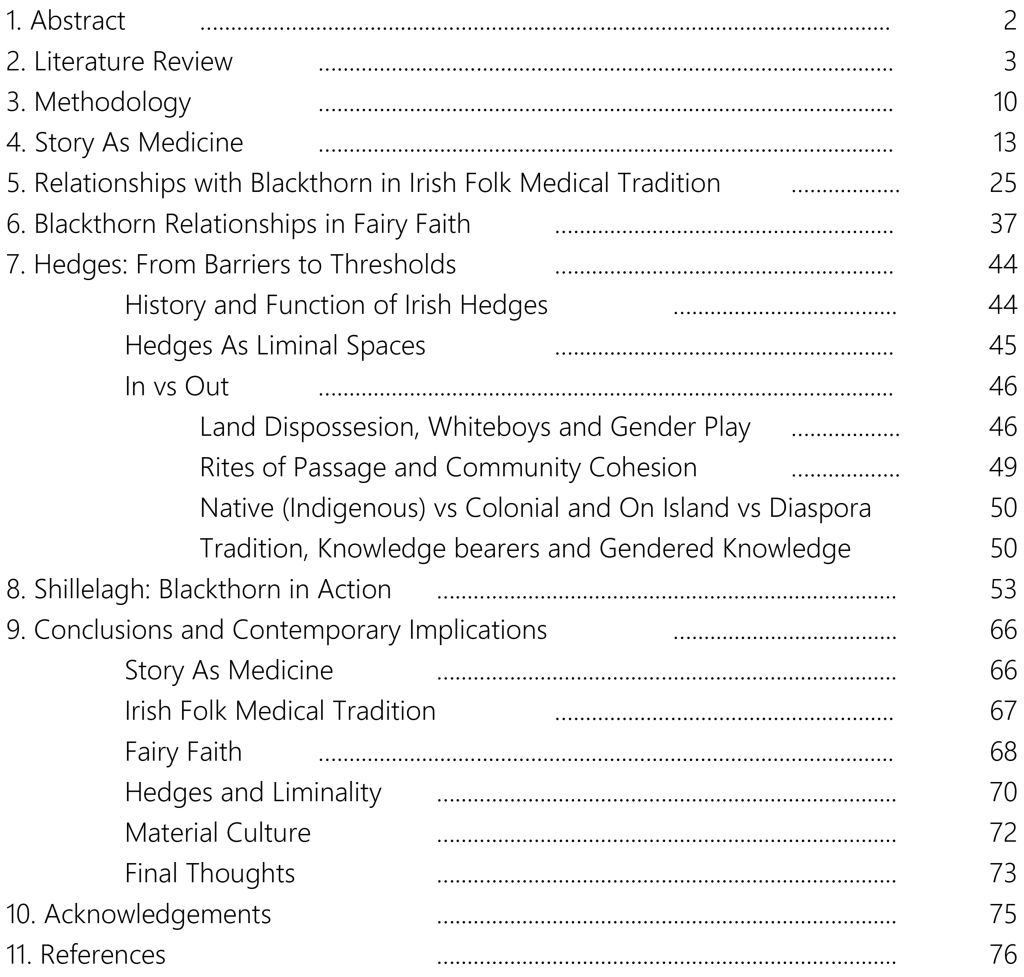
The following chapters will provide an introduction to narrative medicine and establish several vernacular relationships with Blackthorn, which highlight traditional sites of storied healing and open a gateway to implementing story as medicine for contemporary problems. Chapter 4, Story As Medicine, presents an overview of narrative medicine and its ability to collaboratively create new realities. It displays concepts of folk medicine, charms and satire as performances of story medicine before interrogating interactions with allopathic medicine and providing examples of storytelling for social cohesion, regulation and healing. Chapter 5, Relationships with Blackthorn in Irish Folk Medical Tradition, breaks down the culturally assigned and complex characteristics of Blackthorn and outlines phytochemical, magical and practical relationships with the plant on the island of Éire. Chapter 6, Blackthorn Relationships in Fairy Faith, dives further into supernatural associations with Blackthorn and how lore and fairy faith connect people and communities with solutions to social problems and deviant behaviour, while simultaneously providing an outlet for resistance among marginalised subgroups. Chapter 7, Hedges: From Barriers to Thresholds, discusses hedgerows as liminal spaces that transform from protective or oppressive structures to sites of negotiation for complex identities, histories and problems. Chapter 8, Shillelagh: Blackthorn in Action, examines Blackthorn as material culture, with particular emphasis on the shillelagh as a polysemous weapon that imbues its user with ancestral power from both myth and landscape. An exhibition of the object’s crystallised meanings in everyday and celebratory contexts demonstrates intricate relationships of identity, agency and resistance, which continue to be co-created in the present. Chapter 9: Conclusion and Contemporary Implications, summarises lessons from the previous chapters in rapport with thoughts about ongoing problems and potential story medicine solutions.
[1] 2015, 16
[2] 2018
[3] 2007
[4] 2003; 2005
[5] 2001
[6] 1984
[7] 1999
[8] 2001
[9] 1986
[10] The term Irish will be used to identify people and traditions rooted in the island of Éire (and its associated islands, although this broad self-identification may not have been common until the period of Irish nationalism. Prior self-identification would have been more diverse and localized.
[11] 1997
[12] Carey 2019; Carney and Carney 1960; McArdle 2019; Ní Fhloinn 2019
[13] Halpern and Foley 1978
[14] 2019
[15] De Cleene and Lejeune 2003; Hill 1812; Hool 1922; Madaus 1938; Moloney 1919; Woodville 1790-1794; Wyse Jackson 2014
[16] Locke 2017; Mac Coitir 2015; Vickery 1995; 2019
[17] Irish stick fighting
[18] 2004; 2007
[19] 1962
[20] 1971
[21] 1997
[22] 1998
[23] 1987
[24] 1993; 1997
[25] 1999, 102
[26] 1969, 96
[27] 2015
[28] Bakhtin 1984
[29] 1987, 3
[30] Falassi 1987
[31] Upton 2015, 15
[32] Burns 2021
[33] Moore 1997; McGee and Warms 2020
[34] “the tangible yield of human conduct” (Glassie 1999, 41)
[35] “many voiced” (Turner 1984, 16)
[36] “having various meanings or values” (Turner 1984, 16)
[37] “being open to several or many meanings” (Turner 1984, 16)
[38] Turner 1984
[39] Turner 1984
[40] Glassie 1999
[41] Glassie 1999
[42] Cashman 2006, 137
[43] Digital archive of the National Folklore Collection, which contains the entire School’s collection and a growing number of entries from Main Manuscript Collection
[44] Bataireacht, Filipino martial arts and Lua (Hawaiian)


Leave a comment