
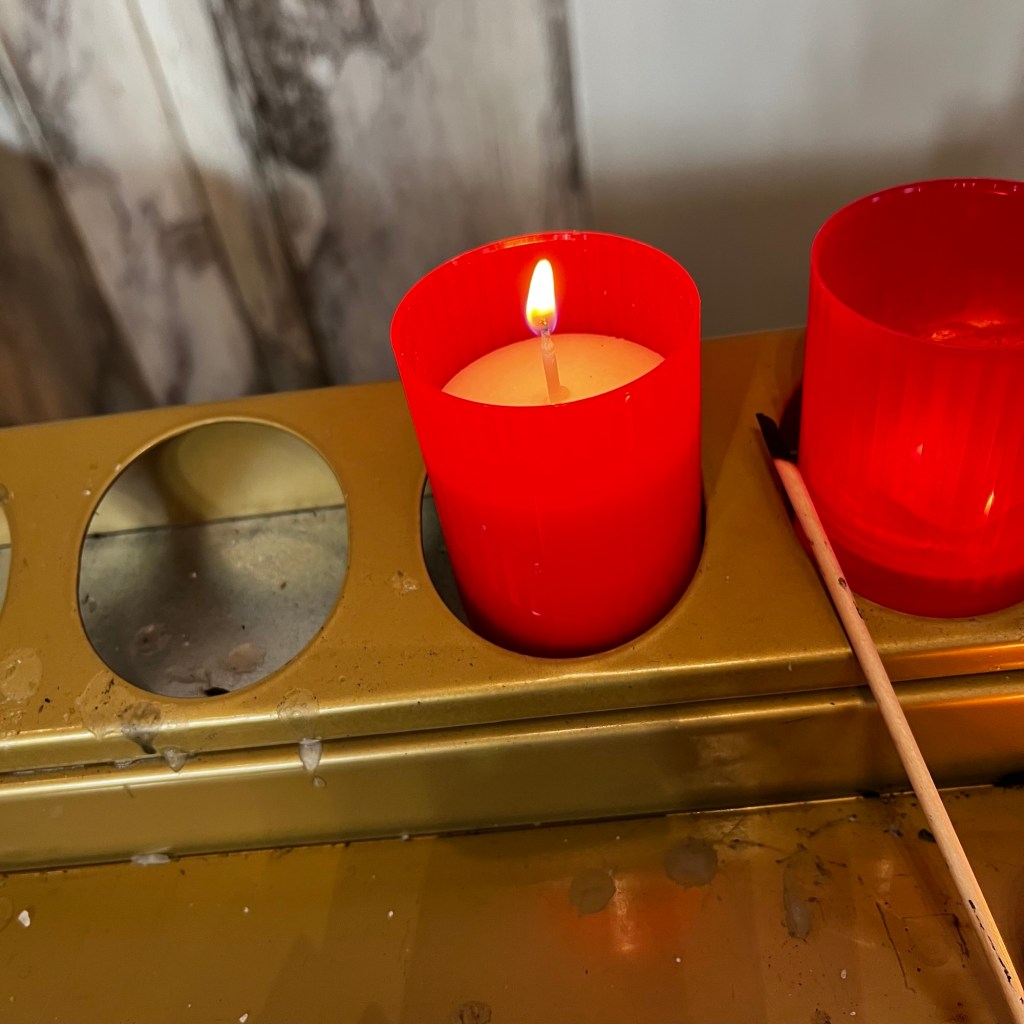
I recently visited the shrine and relics of St Valentine at Whitefriar Street Church in Dublin. The reliquary, containing bits of blood-tinged bone was uncovered during one of the many church/monastery reconstructions above the saint’s grave and was gifted to Irish Carmelite, John Spratt by Pope Gregory XVI in 1835. Although the remains were placed in storage after Pratt’s death, a midcentury church renovation included a shrine, which now houses the reliquary and is topped with a statue carved by Irene Broe. Visitors are welcome any time between masses and it is particularly popular with couples on Valentine’s Day.
The hagiography of St Valentine presents him as a bishop of Rome, who was persecuted and eventually executed for his evangelism. While under house-arrest, he was said to have restored the sight of a young girl. Unsanctioned legend tells of a letter he later sent to her, signed your Valentine.
Another legend speaks of Valentine performing secret Christian weddings, which protected men from conscription during a time when new marriages were banned.
Although this holiday has become overly commercialized, partially through the monetization of these legends, it has roots in the Roman fertility festival of Lupercalia and was not, as is commonly stated, invented by hallmark. Capitalism and oppressive heteronormative expectations have shaped this modern holiday, but here’s a bit of blood-tinged bone to remind us that resistance is love.

“On St Valentine’s day it used to be a great practice to write letters and post them to people without singing (sic) their proper name.” – NFCS 968:75
“There is an old belief that the rooks choose their mates on St. Valentine’s Day. They then begin preparing their nests early in February.” – NFCS 582:192
 Bridging Appalachia
Leave a comment